What Is Industrial Air Pollution Control Equipment? Types and Applications
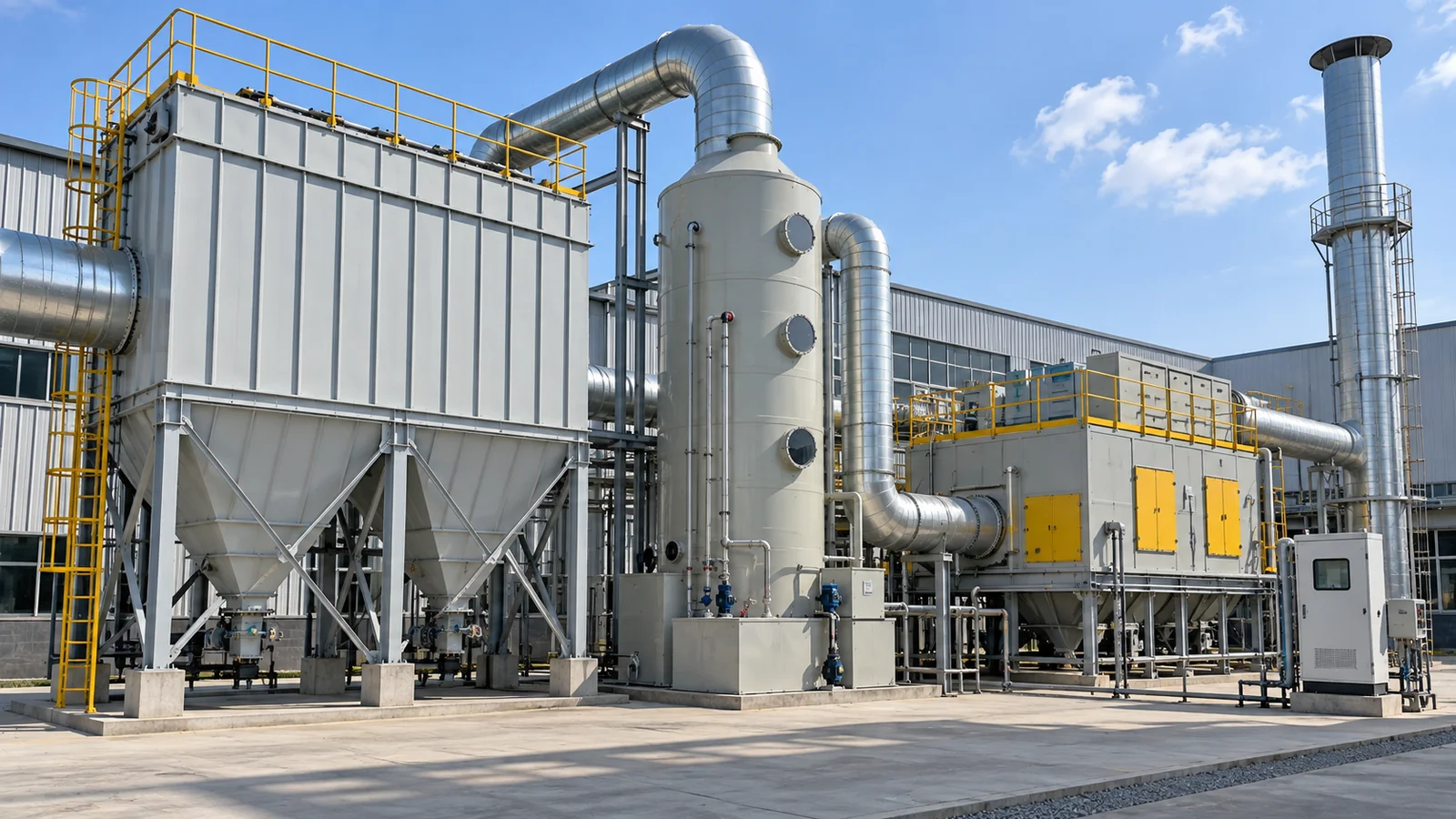
Industrial air pollution control equipment is the group of technologies used to capture, remove or transform pollutants in industrial exhaust streams. The appropriate equipment depends first on what is in the gas: solid particles, mist droplets, soluble or reactive gases, volatile organic compounds (VOCs), or a combination. A fabric dust collector, wet scrubber, electrostatic precipitator and catalytic oxidizer do different jobs. None should be treated as a universal solution for every industrial emission.
Huisheng supplies environmental monitoring instruments and lists pollution-control equipment as a supplementary project product family. Its range includes dust collectors, scrubbers, electrostatic equipment and VOC treatment products alongside emission monitoring systems. This article explains how the principal treatment technologies differ, what conditions affect selection, and why pollution removal and stack monitoring should be planned as related but separate functions.
What Does Industrial Air Pollution Control Equipment Remove?
Start with the pollutant and its physical or chemical behavior, not with a catalog photo. Different compounds require different removal mechanisms. In an actual exhaust stream, multiple pollutant classes may be present simultaneously.
| Pollutant group | Typical characteristics | Technology families to investigate |
|---|---|---|
| Particulate matter | Solid dust, soot or suspended particulate | Fabric filters, cartridge collectors, cyclones and electrostatic collection |
| Acidic or reactive gases | Gases that may be absorbed or react with a scrubbing solution | Wet absorption and chemical scrubbing |
| VOCs and organic vapors | Compounds with different volatility, concentrations and treatment behavior | Adsorption, thermal or catalytic oxidation and other process-specific methods |
| Mists and aerosols | Entrained droplets and fine wet particles | Mist separation and wet electrostatic collection where suitable |
These are engineering starting points, not proof that any listed device alone can achieve a particular outlet concentration. Technology selection also depends on safety, chemistry, process variation and relevant project standards.
Main Types of Industrial Air Pollution Control Equipment
Baghouse and Cartridge Dust Collectors
A baghouse captures suspended particles using fabric bags; cartridge collectors use different filter-element structures, commonly pleated media. Their dust-loading behavior, filtration area, cleaning and maintenance requirements depend on design. Neither basic device is intended to remove all gas-phase pollutants solely by mechanical filtration. Huisheng lists Baghouse and Cartridge Dust Collector as a specific product direction. Selection requires actual dust and gas data rather than relying on the category name.
Wet Scrubbers and Absorption Towers
Wet scrubbers bring a gas stream into contact with a liquid. For particulate control, collection depends on gas-liquid contact, droplet behavior and separation. For soluble or reactive gases, absorption and, where applicable, chemical reactions influence treatment. A Spray Scrubber Tower is an actual Huisheng product direction, but the suitable liquid chemistry, materials and gas-removal scope must be checked against each exhaust stream.
Electrostatic Precipitators and Wet ESP
Electrostatic precipitators use electrical forces to collect charged particles. A wet electrostatic precipitator (WESP) uses a wet collection or cleaning arrangement and may be considered for fine particles or mist in suitable humid process streams. Huisheng lists a Wet Electrostatic Precipitator product. Its specific configuration and performance cannot be inferred from general industry descriptions.
Adsorption and VOC Treatment Systems
Adsorption captures certain vapor compounds on a suitable medium, such as activated carbon. Performance depends on compound properties, inlet concentration, humidity, temperature, loading and media management. Capacity is finite; the adsorbent must eventually be replaced or regenerated according to the design. Huisheng’s VOC Exhaust Gas Treatment Equipment entry represents a category of approaches rather than proof that every VOC stream is suitable for one configuration.
Catalytic and Thermal Oxidation
Oxidation systems convert selected organic pollutants by controlled chemical reaction. Thermal and catalytic routes differ in required conditions and their sensitivity to exhaust composition. Process safety, temperature, concentration, catalyst compatibility and by-products must be evaluated. Huisheng’s RCO Catalytic Combustion Equipment is relevant to this category; no universal destruction efficiency should be assigned to it without product-specific test data.
| Technology | Primary treatment mechanism | Major selection limitation |
|---|---|---|
| Baghouse / cartridge | Solid-particle filtration | Moisture, loading, dust behavior and safety |
| Wet scrubber | Gas-liquid contact or absorption | Solubility, reagent use and liquid waste |
| Wet ESP | Electrostatic particle / mist collection | Gas conditions and design-specific collection |
| Adsorption | Capture of suitable vapors on media | Capacity, humidity and media management |
| Oxidation | Controlled reaction of applicable organic compounds | Composition, energy and process safety |
How Do You Choose Equipment for an Industrial Exhaust Stream?
Identify Pollutants and Concentrations
Dust loading, particle distribution, acid-gas identity and VOC composition are not interchangeable input data. The same total exhaust flow can require completely different treatment when the pollutant composition changes. For a mixed stream, identify which pollutants must be controlled and how each will be measured.
Record Airflow, Temperature and Humidity
Design volumetric flow, operating temperature, moisture and condensation behavior affect collection area, media durability, absorption chemistry and equipment sizing. The measurement conditions and units used for gas volume should be stated consistently. Do not compare nominal capacities if their reference conditions differ.
Check Corrosion, Fire Hazards and Operating Duty
Corrosive gases affect material selection. Combustible dusts and flammable or potentially explosive vapor mixtures need dedicated process-safety assessment. Intermittent or rapidly changing production cycles can create different demands from steady-state operation. Access for maintenance and handling of captured dust, used sorbent or scrubber liquid must be included in the project definition.
Why Are Multiple Treatment Technologies Sometimes Combined?
A single industrial source can emit different pollutants. A project may need pretreatment, primary control and additional polishing or conditioning, but there is no mandatory universal sequence. For example, particulate removal may be considered for a dusty stream before other treatment stages where that is compatible with process safety and chemistry. A stream with soluble gases may need suitable scrubbing, while a high-humidity aerosol stream may justify evaluation of wet electrostatic collection.
These examples describe possible design questions, not Huisheng-installed projects or pre-approved flow diagrams. The actual arrangement must be determined from measured emissions, applicable requirements and an engineering assessment.
Air Pollution Control Equipment vs. Emission Monitoring Equipment
Pollution control and emission monitoring are different functions. Control equipment acts on the exhaust stream to reduce or transform pollutants. Monitoring equipment measures specified parameters using a defined sampling and analytical method. A low dust-collector pressure drop, an operating fan or a running scrubber pump does not by itself establish the actual outlet emission concentration.
| Question | Pollution control | Emission monitoring |
|---|---|---|
| Primary purpose | Capture, remove or transform pollutants | Measure and record selected emission parameters |
| Typical equipment | Baghouse, scrubber, WESP, oxidation system | CEMS, stack-gas analyzer, dust monitor |
| Key specification | Inlet conditions and target removal duty | Measured component, range, method and data quality |
| Does it prove compliance alone? | No | No; appropriate regulatory methods and quality procedures still apply |
Huisheng also lists a Continuous Emission Monitoring System (CEMS) product family. The scope of the monitoring package must match the regulated parameters and site conditions. Pollution-control devices do not automatically contain a CEMS, and monitoring instruments do not replace treatment equipment.
What Should Buyers Prepare Before Requesting a Solution?
A practical technical inquiry should begin with the industrial process, emission source, pollutant identities and expected inlet concentrations. It should then document exhaust flow, temperature, humidity, corrosive or hazardous constituents, operating schedule and any existing pretreatment. Buyers should also explain the required outlet condition, applicable project standards, available installation space, utilities, dust or wastewater handling arrangements, and desired monitoring interfaces.
These details help determine which technologies merit evaluation and which product boundaries remain to be confirmed. Huisheng’s environmental protection equipment category brings together pollution-control product types. For a project discussion, buyers can share industrial emission and monitoring requirements with Huisheng, including the process description, available measurements, target parameters and site constraints.
The correct starting point for industrial air pollution control is the pollutant and process condition, not the equipment name. From there, the control mechanism, system arrangement and independent emission-verification needs can be evaluated in a consistent way.