What Is a Baghouse Dust Collector? How It Works and Key Components
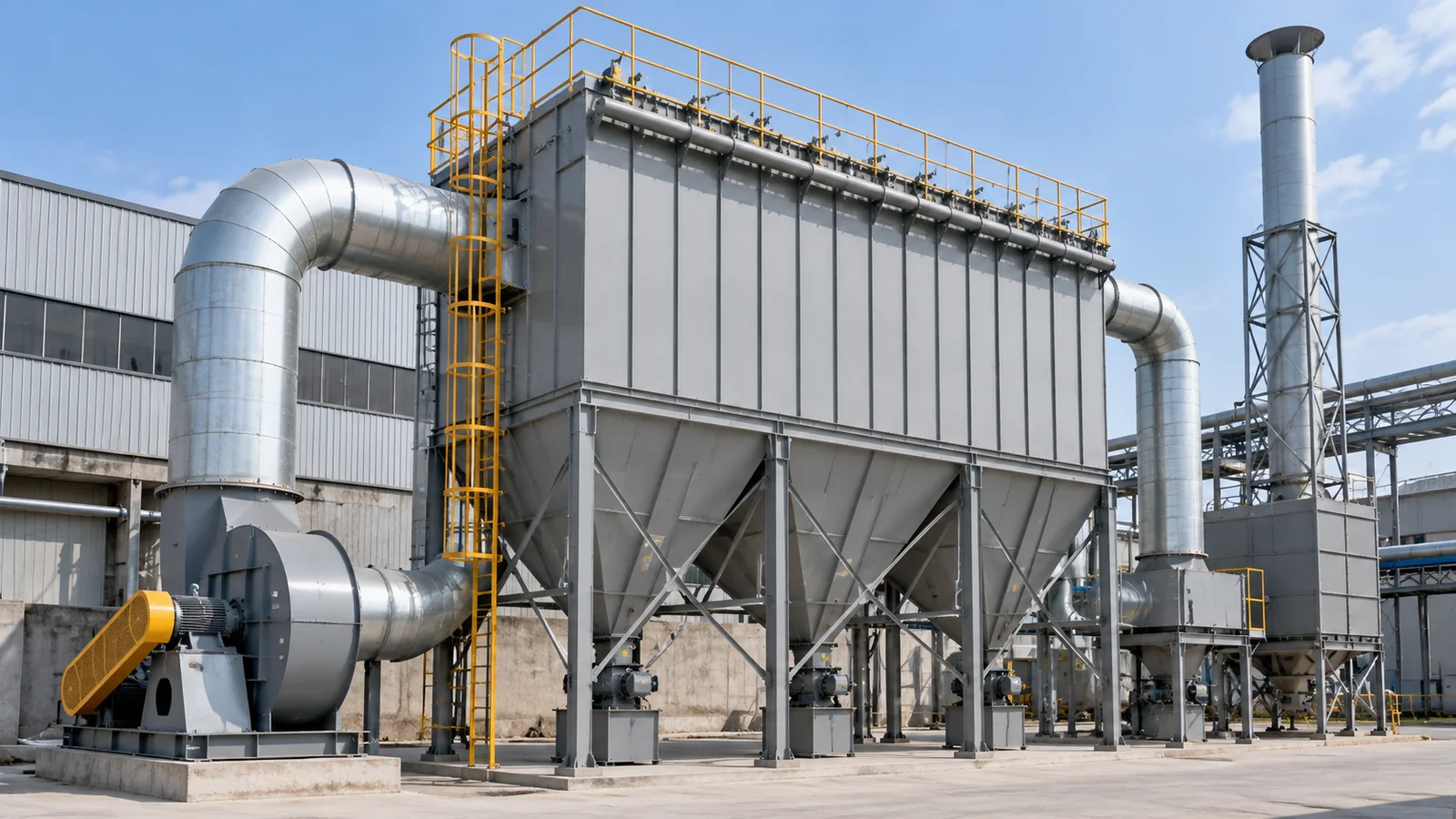
A baghouse dust collector is an industrial particulate-control device that uses fabric filter bags to separate suspended dust from an exhaust gas stream. Dust-laden air enters the collector, particles accumulate on the filter medium and the developing dust cake, and cleaned gas passes toward the outlet. A cleaning mechanism periodically dislodges deposited dust so it can collect in a hopper and be removed. A baghouse therefore combines filtration, cleaning, dust discharge, airflow management and inspection—not simply a set of fabric sleeves.
Baghouses primarily control particulate matter. They do not, by their basic filtration mechanism alone, remove every gaseous pollutant such as a VOC or an acid gas. Huisheng lists Baghouse and Cartridge Dust Collector among its environmental-protection equipment, alongside products supporting industrial emission monitoring. The right configuration depends on the actual dust and gas conditions rather than on an equipment label alone.
How Does a Baghouse Dust Collector Work?
Dust-Laden Gas Enters the Collector
A fan and duct system convey gas from a dust-generating operation to the collector. The inlet and gas-distribution arrangement influence how particles reach the filter area. A poorly matched inlet can cause uneven loading or excessive local abrasion; the preferred arrangement depends on the collector design and the dust properties. The fan and all ductwork may or may not be included in the supplied collector package, so system boundaries should be defined before a quotation.
Filter Bags and the Dust Cake Capture Particles
As gas passes through the filter medium, particles are captured by several filtration mechanisms. Deposited particles gradually form a dust cake, which can become an important part of the filtering layer. Dust is not captured solely because each individual particle is larger than an opening in the fabric. Filter properties, particle characteristics and the condition of the deposited layer all affect collection behavior.
The dust cake also adds resistance to gas flow. A baghouse must manage the trade-off between effective particulate capture and a workable pressure drop across the filters. A single claimed filter-medium rating is not enough to predict complete-system emission performance under every process condition.
Cleaning and Dust Discharge Keep the System Operating
As particles accumulate, a cleaning system periodically removes part of the deposited layer. Released dust falls toward the hopper and is transferred through a suitable discharge arrangement. Cleaning must be coordinated with operating airflow and dust removal. A blocked discharge, unsuitable cleaning settings or persistent moisture can compromise operation even when the bags themselves are intact.
What Are the Main Components of a Baghouse?
| Component | Function | Specification question |
|---|---|---|
| Inlet and gas distribution | Introduce and distribute dust-laden gas | How are flow and abrasion managed? |
| Filter bags | Provide the primary filter medium | Which medium suits the dust and gas conditions? |
| Bag cages or supports | Maintain shape in designs that require them | Which bag and support arrangement is specified? |
| Tubesheet and seals | Support elements and separate gas zones | How are leakage paths controlled? |
| Cleaning equipment | Remove deposited dust | Which cleaning method and utilities apply? |
| Hopper and discharge | Collect and remove released dust | How is bridging or blockage addressed? |
| Fan, ducts and controls | Support airflow and operation | Are these included in the project scope? |
These are typical functional elements, not a verified bill of materials for every Huisheng product. A complete dust collection installation may require additional ductwork, explosion or fire protection provisions, access platforms and appropriate monitoring, depending on its design and risks.
Pulse-Jet, Reverse-Air and Shaker Cleaning
The cleaning method changes how the dust layer is removed and how the filter system is operated. The three traditional categories are not interchangeable simply because all use fabric bags.
| Method | Basic mechanism | What to evaluate |
|---|---|---|
| Pulse-jet | Short pulses of compressed air flex or disturb the filter bags | Compressed-air supply, media design and cleaning controls |
| Reverse-air | Flow is reversed through a filter section to release deposited dust | Compartment operation and filter construction |
| Shaker | Mechanical movement dislodges accumulated dust | Cleaning cycle, filter mounting and mechanical wear |
Pulse-jet cleaning is common in industrial systems, but it should not be assumed that a collector advertised as a baghouse necessarily uses a particular pulse pressure, cleaning frequency or bag arrangement. Those are design-specific values.
What Determines Baghouse Filtration Performance?
Airflow and Air-to-Cloth Ratio
Design airflow establishes how much gas must move through the filtration area. The air-to-cloth ratio relates the volumetric gas flow to the available filter area, with consistent units. A higher ratio means more gas flow per unit of fabric area, but the appropriate value depends on dust loading, particle behavior, medium and cleaning method. A quoted airflow figure without its design basis cannot settle the selection.
Dust Properties, Temperature and Filter Media
Particle size distribution, inlet concentration, abrasiveness, stickiness and hygroscopic behavior can alter both collection and cleaning. Gas temperature, moisture, corrosive constituents and condensation potential influence the filter medium and equipment arrangement. A material suitable for dry mineral dust should not automatically be selected for sticky, condensing or corrosive exhaust.
Pressure Drop and Cleaning Balance
Differential pressure is an operational signal. Increasing pressure drop can indicate accumulation or restricted flow, while unusually low or unstable readings may require investigation of operating conditions, sensors, leaks or the cleaning system. No single pressure reading proves a collector’s particulate emissions are acceptable. Outlet concentration, when required, must be established by an appropriate emission measurement method.
Where Are Baghouse Dust Collectors Used?
Fabric filtration may be considered at dry particulate sources such as cement and mineral processing, aggregate handling, certain foundry operations, powder transfer and other industrial dust-generating processes. For every application, the essential questions are the properties and loading of the dust, the volume and temperature of the gas, and whether the medium can be cleaned reliably.
Moisture and condensation can lead to blinding, and sticky material can resist release from the fabric. Combustible dust introduces fire and explosion hazards that require a dedicated safety assessment and suitable protective design. Conventional filtration should never be described as universally appropriate for hazardous dust, extreme temperatures or every industrial emission stream.
Baghouse vs. Cartridge Dust Collector
Baghouses and cartridge collectors both use filtration media to remove particles, yet their element geometry and available configurations are different. A baghouse uses elongated fabric bags; a cartridge collector typically uses pleated cartridge elements. That difference can influence element density, flow arrangement, dust release and maintenance access.
| Comparison | Baghouse | Cartridge collector |
|---|---|---|
| Primary element | Fabric bag | Usually pleated cartridge |
| Design consideration | Bag length, support and cleaning arrangement | Pleat loading, element access and cleaning |
| Selection basis | Gas conditions, dust characteristics and duty | Gas conditions, dust characteristics and duty |
| Universal performance winner? | No | No |
Huisheng’s combined environmental protection equipment range allows project buyers to review pollution-control categories. A combined product listing does not establish that bag and cartridge designs share identical filter specifications or performance.
How Do You Know if a Baghouse Is Working Properly?
Good operation requires a distinction between collector health indicators and emission measurement. Differential pressure, inlet temperature, fan condition, cleaning activity and hopper discharge can help operators identify changes in the system. Bag-leak detection, opacity or outlet particulate measurements may serve other purposes depending on the monitoring plan.
| Indicator | What it helps assess | What it cannot prove alone |
|---|---|---|
| Differential pressure | Flow resistance and filtration operating trends | Actual outlet particulate concentration |
| Cleaning activity | Pulse or cleaning-cycle operation | Emission compliance |
| Hopper discharge | Collected dust removal | Filter integrity |
| Outlet particulate measurement | Emissions under the applicable measurement method | All mechanical components operating correctly |
Where a project requires stack-emission measurement, Huisheng also provides Continuous Emission Monitoring System (CEMS) product information. The precise measured parameters and the appropriate monitoring arrangement must be determined for the project; a baghouse does not automatically include a CEMS.
What Should Buyers Confirm Before Selecting a Baghouse?
A useful baghouse inquiry should identify the process and dust source, design gas flow and operating basis, inlet dust loading, particle characteristics, temperature, moisture, corrosive components and operating hours. Buyers should also state the desired outlet condition and measurement method, available footprint, utility supply, filter-access requirements, dust-discharge method and any applicable combustible-dust hazards.
These details determine whether fabric filtration is a reasonable candidate and which equipment boundaries need technical confirmation. For the specific product and configuration scope, buyers can discuss dust-collection requirements with Huisheng and share the process data, target pollutants and site constraints.
In summary, a baghouse is a fabric-filtration system for particulate control. Its results depend on the complete gas path, filter medium, cleaning, dust discharge, operating conditions and appropriate monitoring—not on the filter bags alone.