How a Wet Electrostatic Precipitator Works: Particle Charging, Collection, and Washing
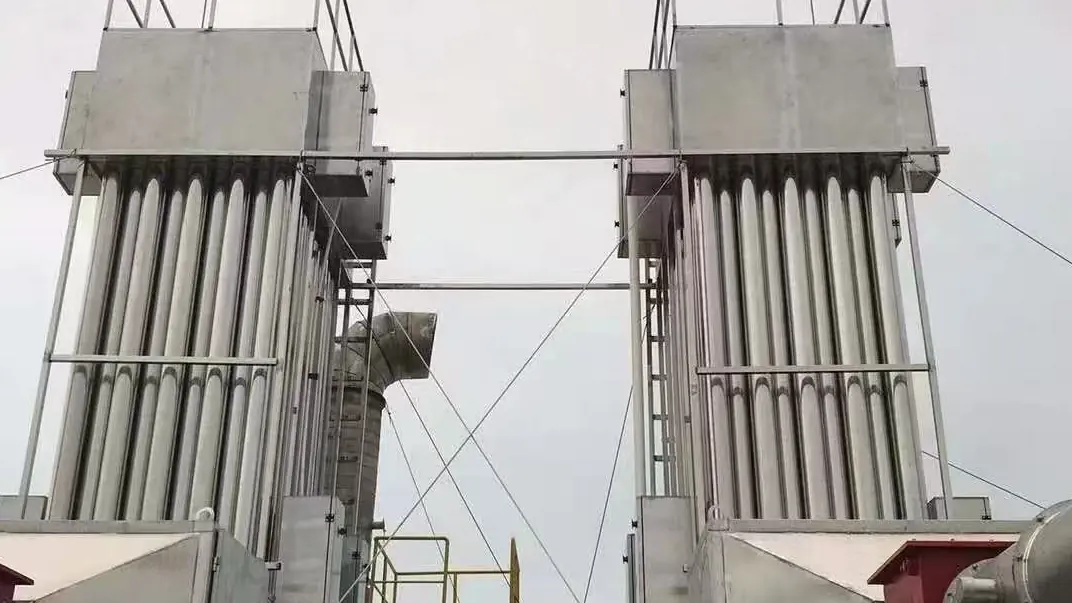
A wet electrostatic precipitator (WESP) removes suspended particles and liquid droplets by charging them electrically, driving them toward collecting surfaces, and washing the deposits into a drainage system. The electric field performs the principal collection task; the liquid removes accumulated material from the surfaces. Understanding how a wet electrostatic precipitator works therefore requires following both the gas path and the captured material’s route out of the equipment.
Huisheng lists WESP equipment for fine dust, acid mist, tar mist and aerosols in humid flue gas. Its published washing arrangement combines continuous wetting with intermittent flushing. These product details illustrate one configuration rather than a universal arrangement for every WESP.
How Does Gas Move Through a Wet Electrostatic Precipitator?
Gas Entry and Distribution
An inlet section distributes the incoming gas through the collection region. Distribution matters because different flow paths can provide different opportunities for particle charging and collection. A fast-moving portion of the stream has less time to pass through the active region than the same path at its design velocity.
The gas must pass through the intended electrical collection passages, not simply enter and leave the casing. Inlet layout and internal distribution therefore form part of the working process, even though they do not themselves create the collecting force.
Discharge Electrodes and Collecting Surfaces
Common configurations include gas flowing between collecting plates and gas passing through collecting tubes with discharge electrodes along their axes. These are examples, not interchangeable descriptions of every unit. Plate and tubular layouts can have different flow directions and electrode arrangements. EPA describes these configurations separately in its wet ESP technical fact sheets.
The key distinction is functional: discharge electrodes generate the ionizing region, while collecting surfaces receive the charged particles or droplets. The casing, inlet and outlet connect those functions into a gas-handling device.
How Does Corona Discharge Charge Particles and Droplets?
Creating Ions Around the Discharge Electrode
A high-voltage power supply establishes an electric field between the discharge electrode and collecting surface. Near the discharge electrode, the local field can become strong enough to ionize the gas, producing a corona discharge. The resulting ions provide the means of charging suspended material.
Corona discharge is not the same as repeatedly creating large electrical arcs. The power supply and controls must maintain operating conditions suitable for the particular electrode geometry and gas stream. A higher voltage rating alone does not establish stronger collection in service.
Transferring Charge to Suspended Material
As particles and droplets encounter ions, they acquire electrical charge. Charging and collection are linked but distinct: gaining charge makes a particle responsive to the electric field, but the particle must still reach a collecting surface before leaving the equipment. EPA’s WESP fact sheet describes this sequence from corona-generated ions to particle charging and collection.
How Does the Electric Field Collect Charged Material?
Migration Toward the Collecting Surface
The field exerts a force on charged material and causes it to migrate toward the collecting surface while the gas continues through the passage. Particle motion reflects both electrical forces and resistance from the gas. A WESP therefore separates particles from the flowing stream rather than passing the entire gas flow through a filter fabric.
Why Gas Flow and Collection Time Matter
Successful collection requires sufficient opportunity for charged material to reach the surface. Gas flow, available collection area, field conditions and particle characteristics influence that opportunity. Increasing gas flow through unchanged equipment can reduce the time available and alter its performance. These relationships underpin the collection theory described in EPA’s electrostatic precipitator technical manual.
Fine-particle capture is not described adequately by a single overall efficiency figure. A reported total-dust efficiency does not establish the same collection efficiency for every particle size or mist component. Performance claims need a defined pollutant, inlet condition and measurement basis.
How Does Washing Remove Deposits from the Collecting Surfaces?
Continuous Wetting and Intermittent Flushing
Deposited material must leave the collecting surface so that it does not simply accumulate inside the equipment. Depending on the design, liquid can be applied continuously, at intervals, or through a combination of wetting and flushing. The washing arrangement must reach the intended surfaces and remove the collected deposits.
The Huisheng wet electrostatic precipitator product page lists continuous water-film spray plus intermittent plate flushing. This is a specific published equipment description; it does not establish that every wet ESP uses the same cycle, nozzle arrangement or water demand.
Carrying Collected Material into the Drainage System
The liquid carries captured material into a sump or another drainage and collection arrangement. Capture transfers pollution out of the gas stream; it does not make that material disappear. The resulting liquid or slurry needs a suitable handling route.
Some designs recirculate part of the liquid, with separation, treatment or discharge as required by the process. Recirculation does not remove the need to manage collected contaminants. EPA’s wet ESP guidance describes both drainage and possible liquid recycling.
Pumps, treatment equipment and connecting pipework may belong to a wider installation rather than the precipitator’s supply package. Their inclusion should be confirmed when defining the equipment scope.
Why Can a WESP Collect Fine Dust and Mist?
Collecting Suspended Solids and Liquid Aerosols
The electrical collection mechanism acts on charged suspended material, including solid particles and liquid droplets. Fine dust and acid mist can therefore be relevant targets when the equipment and gas conditions are suitable. A moist or sticky deposit must still be compatible with the collecting surfaces, wash liquid and drainage arrangement.
Where cooling causes a condensable substance to form droplets before collection, the WESP can capture that aerosol fraction. This does not mean every vapor will condense under the available process conditions.
Distinguishing Aerosol Capture from Gas-Phase Treatment
An aerosol is a suspension of solid particles or liquid droplets in gas. A gas-phase pollutant is present at the molecular level. Capturing acid mist or tar droplets does not, by itself, demonstrate removal of gaseous acid compounds or all volatile organic compounds.
Any additional removal through absorption, condensation or another process needs its own technical basis. The treatment objective must identify the pollutant’s form at the WESP inlet rather than rely on a broad label such as “chemical fumes.”
What Keeps the Collection and Washing Cycle Working Properly?
Electrical Conditions and Gas Distribution
Changes in voltage, current or sparking behavior can indicate that electrical operation has changed. They need to be interpreted alongside the gas conditions, equipment design and operating history. A power supply can be energized while part of the gas stream still receives inadequate treatment.
Washing Coverage, Drainage, and Material Compatibility
The washing and drainage functions must operate as a connected path. Poor washing coverage can leave deposits behind; restricted drains can prevent removed material from leaving as intended.
Corrosive gas components and collected contaminants also affect material compatibility. Water alone does not make every construction material suitable for an acid-mist application. Operating temperature must suit the complete wet process, including the materials and intended liquid conditions. Temperature limits should come from the selected design rather than a generic value applied to all WESPs.
Operating Indicators Versus Outlet Performance
Electrical measurements help explain equipment operation. Outlet particulate or mist measurements establish a different fact: what remains in the gas after treatment. Normal-looking voltage and current cannot independently prove a particular outlet concentration. EPA identifies electrical operating indicators and outlet particulate measurements as distinct elements of ESP performance monitoring.
Verification needs the agreed pollutant measurement and test method under defined operating conditions. To discuss an installation, share your WESP application with Huisheng, including inlet gas conditions, particle or droplet characteristics, the required outlet result and the intended wash-liquid handling route. These details connect the operating principle to a configuration that can be assessed for the actual duty.